Thursday, August 7, 2014

Sunday, August 3, 2014
Extra Credit 2
Hubble 3D IMAX + Endeavor


Hubble 3D in IMAX is
spectacular. I have always been fascinated by nature and documentaries are my
favorite method of learning about natural phenomena. This one is nothing short
of amazing. Although it is somewhat short with a runtime of just under 50
minutes, it provides you with a glimpse into the lives of a group of astronauts
tasked with making repairs to the Hubble Space Telescope. It is full of
breathtaking visuals and mind-blowing facts. To see first hand the difficulties
that astronauts must overcome in space gives me a whole new level of respect
for them. The amount of work that goes into a space mission is remarkable in
itself. Everything must be taken into account and overlooking the smallest
detail can be catastrophic. The astronauts are well rehearsed and prepared for
any situation but they still rely on a team of scientists and engineers on the
ground to accomplish their missions. When everything goes off without a hitch
the results are truly astonishing. The images that are produced by the Hubble Space Telescope are like nothing else in existence. The astronauts mention several times throughout the
film that their goal is to unlock the secrets of the universe and the Hubble
Space Telescope enables them to do that by peering deep into the farthest
reaches of the observable universe, fourteen and a half billion years ago, to
just before the big bang. Scientists are able to use this information to try and answer
some age old questions like where do we come from and how did we get here. For the general public or anyone lucky enough to get to see this footage, the images being sent back from the Hubble Space Telescope serve as a beautiful reminder of just how fortunate we are to call planet Earth home and inspires the next generation of potential astronauts and aerospace engineers by showing them what we are already capable of and optimistically hinting at the future. The Space shuttle endeavor has found a permanent home at the California Science Center. I remember seeing the Space Shuttle Endeavor flying over Los Angeles in 2012, it was interesting to get to see it up close and personal and learn more about its past missions and crews. I was surprised at the size of the shuttle when you are standing beside it and how much technology they manage to fit inside the space. I would have liked to be able to enter the cockpit of course but I enjoyed visiting the mission control center instead. The engineering that goes into building something like this is an obvious example of where art meets science and technology. Space is the final frontier as they say for artists, scientists, and technology to converge and create something groundbreaking that will benefit mankind for generations to come. I would absolutely recommend seeing Hubble 3D in IMAX if you ever have the chance and the Endeavor Space Shuttle is a nice little bonus.




Sources
"Space Shuttle Endeavour." Wikipedia. Wikimedia Foundation, 26 July 2014. Web. 3 Aug. 2014. <http://en.wikipedia.org/wiki/Space_Shuttle_Endeavour>.
"." . N.p., n.d. Web. 3 Aug. 2014. <http://blog.al.com/spacenews/2009/05/344876main_pgtonhubblelfightr.jpg>.
"." . N.p., n.d. Web. 3 Aug. 2014. <http://d1jqu7g1y74ds1.cloudfront.net/wpcontent/uploads/2014/06/heic1411a.jpg>.
"." . N.p., n.d. Web. 3 Aug. 2014. <http://www.spacetelescope.org/static/archives/images/wallpaper5/hubble_in_orbit1.jpg>.
"." .
N.p., n.d. Web. 3 Aug. 2014.
<http://upload.wikimedia.org/wikipedia/commons/thumb/6/60/Earth_from_Space.jpg/600px-Earth_from_Space.jpg>.
Extra Credit 1
Bodies Exhibit
I can honestly say
that I will never forget my trip to the Bodies Exhibit in Buena Park, California,
and I would recommend it to anyone who has not yet seen Body World or anything
similar. Science has come a long way to allow us to examine all of the intricacies
of our own physical form as art installations in a museum environment. This would not be
possible without the contributions of the scientists that paved the way. The
Bodies Exhibit does a good job recognizing this and pays homage to some of the
most celebrated scientific advancements that led to our ability to turn our
bodies into works of art. Through a process called plastination you can
effectively turn a human cadaver into an organic statue that will not decay. The water and fats in the body are replaced by certain plastics and any remaining organic material is then eaten away by a corrosive solution. Like a block of organic stone, the treated specimen can be shaped and molded
into any number of forms. Human curiosity and creativity are on full display
here in these educational and aesthetically pleasing models that render the
invisible visible. Not only can we peer under the surface of our skin like
never before, but we can study all of the organic systems individually by
isolating them from the rest of the
body. It is humbling to see the delicate structures that are responsible for
keeping us alive on display. It is truly remarkable to see how all of the
pieces of the puzzle that is the human body fit together and function as a single unit. It is
also inspiring to see natural art installations that reside in our own body.
Some of the structures on display rival any work of art from any artist I have ever seen. The most memorable for me was seeing the entire circulatory system laid out
on a table with all of the blood vessels on full display. Second would have be the bronchial tubes and alveoli of the lungs
suspended in a liquid solution which resembled a beautiful coral reef like
structure. Other notable installations include the human body being cut into
thin slices and sandwiched between glass then stretched over ten feet to make a
surreal display and also an entire section of the museum dedicated to embryonic
development showing every stage of fetal growth starting from the moment of
conception to just before birth in astonishing detail. It is certainly
interesting to see the inner workings of the human body and there is no
question that the installations on display here are works of art achieved
through advancements in science and technology. The Bodies Exhibit is intended
for mature audiences and it may elicit different responses from visitors
examining the ins and outs of the human body. For me, the experience was educational
and revelationary even to see the human body as art and not just a vehicle for
transportation through this life, it taught me to appreciate my healthy body
and I gained a new found respect for the science that made this possible. I would
highly recommend the Bodies Exhibit to anyone remotely interested in learning
about their body. I honestly feel like everyone should be exposed to this kind
of work at least once in their life to gain a better understanding of how their
bodies function.


Sources
"Plastination." Wikipedia. Wikimedia Foundation, 22 July 2014. Web. 3 Aug. 2014. <http://en.wikipedia.org/wiki/Plastination>.
. "." . N.p., n.d. Web. 3 Aug. 2014. <http://en.rotterdam.info/data/offer/offerid5174/large/2010-BODY-WORLDS---The-Story-of-the-Heart--834294456.jpg>
"." .
N.p., n.d. Web. 3 Aug. 2014.
<http://layovertolife.files.wordpress.com/2012/12/pc113804.jpg>.
"." .
N.p., n.d. Web. 3 Aug. 2014. http://media.mlive.com/grandrapidspress/photo/2010/11/9056424-standard.jpg
"." .
N.p., n.d. Web. 3 Aug. 2014.
<https://scribbledigit.files.wordpress.com/2010/10/heart-lungs1.jpg>.
.
Event 3
Fullerton Aboretum


The Fullerton
Aboretum is an excellent example of science and art coming together to create
something beautiful. This is a place where human ingenuity and nature converge.
The result is a beautifully constructed combination of plant species ranging
from woodland to mediteranean to desert climates, something that you would not find in nature. The arboretum offers a
unique experience for visitors to travel between different manufactured
climates to see a variety of plant species from around the globe. For example,
I was able to see a bamboo forest next to a collection of redwood trees, a
garden full of an assortment of roses, various exotic fruits, and a large array
of cacti and other desert plant species. Humans have been engineering plants
and animals through artificial selection and genetic modification for
centuries. In fact, much of the food that we eat today does not exist in
nature. We crossbred plants and selected for traits that would make the fruits
taste better. The result of hundreds of years of artificial selection is the
huge quantity and quality of plant species that exist today. I was unfamiliar with
a lot of the types of plants that I saw at the Arboretum, this is in large part due to
the fact that they are different species that exist in particular climates
scattered around the world, but also many of them are manmade hybrids that I have never heard of before. Some of these included the wooly-leaved white sapote, the white fig, the Pummelo, and the hybrid chestnut. I was familiar with most of the citrus fruit trees and some of the desert plant species like the prickly pear cactus.Of course I recognized the iconic bamboo forest and tall redwood trees as well as the large palm trees and other locally grown species. I had no idea that California’s climate could cater
to such a large range of plant species or that they could coexist in such close
proximity to each other. The arboretum is only 26 acres but offers over 4000
plants. There is also a small waterfall at the entrance that feeds into a stream that empties into a small pond. I was surprised to see how densely populated the streams and ponds were with life. There were plenty of turtles, ducks, tadpoles, and small fish coexisting with the water lilies in the pond. I even saw a large carp jumping out of the water and a single racoon jump into the stream and find shelter under some brush. This is a special place that teaches us about the diversity of the
world’s plant life and the importance of protecting these treasures. If you are a nature lover or just want to escape for the day and enjoy some beautiful scenery I would recommend visiting the Fullerton Aboretum to everyone in sunny southern California.
Sources
"Selective breeding." Wikipedia. Wikimedia Foundation, 29 July 2014. Web. 3 Aug. 2014. <http://en.wikipedia.org/wiki/Selective_breeding>.
Event 2
Bowers Museum
I visited the Bowers Museum in Santa Ana, California today for the first time and was pleasantly surprised by what I saw. First off, the entrance to the museum is a beautiful little plaza reminiscent of a Spanish courtyard, the building itself is much larger than it appears to be from the outside, with two stories and a total of ten separate exhibitions spaced throughout the museum. These ranged from the ancient Mayans, to the first Californians, to Chinese immigrants, Mexican ceramics, and other ancient arts from the Pre-Columbian era to the Pacific Islands. Also, Chuck Jones, the famous American animator, cartoon artist, screenwriter, producer, and director of animated films was featured in his own exhibit called Doodles of a Genius. This was very exciting for me to see as I had just finished learning about him last quarter in my History of American Animation course at UCLA, and I found his passion for his lifework to be very inspirational, even if it was just drawing doodles. He earned four Oscars for his work, one of which was the coveted life time achievement award. It was interesting to take a peek into the mid of a genius filmmaker by examining some of his private sketches and learning about his life’s work. To connect what I learned from my visit to the Bowers Museum to topics that we have covered in class takes me to the subject of technology throughout the ages. Nearly every display focuses on technology in some way and is presented in a way that is aesthetically pleasing. Some of the items on display are purely aesthetic, while others are technological artifacts presented as art. For example, I saw hunter-gatherer technology in the form of stone blades and arrows, also on display were Native American hand woven baskets, ancient Mayan artifacts including a replica tomb of Lord Pical, as well as ancient Chinese jade statues and replica terracotta soldiers. Other examples include the origins of Chinese calligraphy and the evolution of transportation from horseback to boat to train and so on. There were also sections of the museum that were dedicated purely to art. Apart from the Chuck Jones section which showcased his sketches, there were the California impressionist paintings and the sacred realm temple murals done by a Buddhist monk. These consisted of beautiful illustrations of nature and the supernatural. There is no shortage of things to see at the Bowers Museum and I would recommend it to anyone in the area who appreciates art and technology throughout the ages.
I visited the Bowers Museum in Santa Ana, California today for the first time and was pleasantly surprised by what I saw. First off, the entrance to the museum is a beautiful little plaza reminiscent of a Spanish courtyard, the building itself is much larger than it appears to be from the outside, with two stories and a total of ten separate exhibitions spaced throughout the museum. These ranged from the ancient Mayans, to the first Californians, to Chinese immigrants, Mexican ceramics, and other ancient arts from the Pre-Columbian era to the Pacific Islands. Also, Chuck Jones, the famous American animator, cartoon artist, screenwriter, producer, and director of animated films was featured in his own exhibit called Doodles of a Genius. This was very exciting for me to see as I had just finished learning about him last quarter in my History of American Animation course at UCLA, and I found his passion for his lifework to be very inspirational, even if it was just drawing doodles. He earned four Oscars for his work, one of which was the coveted life time achievement award. It was interesting to take a peek into the mid of a genius filmmaker by examining some of his private sketches and learning about his life’s work. To connect what I learned from my visit to the Bowers Museum to topics that we have covered in class takes me to the subject of technology throughout the ages. Nearly every display focuses on technology in some way and is presented in a way that is aesthetically pleasing. Some of the items on display are purely aesthetic, while others are technological artifacts presented as art. For example, I saw hunter-gatherer technology in the form of stone blades and arrows, also on display were Native American hand woven baskets, ancient Mayan artifacts including a replica tomb of Lord Pical, as well as ancient Chinese jade statues and replica terracotta soldiers. Other examples include the origins of Chinese calligraphy and the evolution of transportation from horseback to boat to train and so on. There were also sections of the museum that were dedicated purely to art. Apart from the Chuck Jones section which showcased his sketches, there were the California impressionist paintings and the sacred realm temple murals done by a Buddhist monk. These consisted of beautiful illustrations of nature and the supernatural. There is no shortage of things to see at the Bowers Museum and I would recommend it to anyone in the area who appreciates art and technology throughout the ages.


Sources
"Chuck Jones." Wikipedia. Wikimedia Foundation, 8 Jan. 2014. Web. 3 Aug. 2014. <http://en.wikipedia.org/wiki/Chuck_Jones>.
"." . N.p., n.d. Web. 3 Aug. 2014.
<http://static.rogerebert.com/uploads/blog_post/primary_image/balder-and-dash/chuck-jones-thats-not-all-folks/primary_jones_chuck-thumb-350x432-25307.jpg>.
Event 1
Discovery Science Center


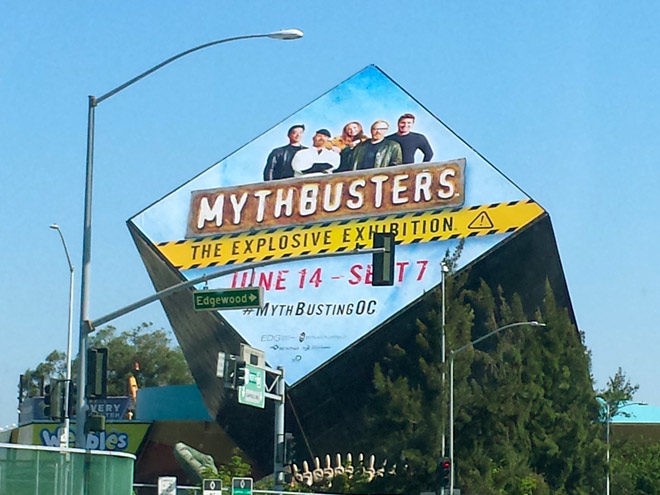
I visited the Discovery Science Center in Orange
County, California while they were showing the Mythbusters Explosive
Exhibition. This was a separate installation from the standard exhibit which
presented some memorable moments from the Mythbusters television show. Some of
the custom built contraptions were on display there, like the Jaws replica
shark, and the duct tape canoe, among other things. There was also a live show
component to the exhibit that asked the question, can a human dodge a paintball
fired from a gun? By using the scientific method to conduct a simple
experiment, the two hosts with help from members of the audience were able to
test if a human could potentially dodge a bullet fired from a paintball gun.
After several attempts, they concluded that you can in fact dodge a paintball
if it is fired from a distance of around 200 feet. From that distance you have
almost a full second to get out of the way of the bullet before it hits you.
There were other experiments there as well which you could participate in to
find the answer. For example, I learned that you get more wet when you run
through the rain than when you walk under certain conditions and that a plane
can take off from a conveyor belt. I also got to pull the table cloth out from
under the dinnerware on a small table and was successful at throwing a playing
card into a cork board target. Other exhibitions included a bench hanging from
two phone books that could support your weight and a ledge where you could test
your grip strength and endurance in a fabricated life threatening situation.
Speaking of grip strength and endurance, at the standard Discovery Science
Center, I was able to pull myself up a seated pulley machine and lay on a bed
of nails which I had not done since the last time I visited the center as a
child. That is one thing that I noticed immediately, that the Discovery Science
Center is aimed at children and it felt a bit awkward visiting there again as
an adult without any children of my own. This does not take away from the fact
that it is an excellent source of basic scientific knowledge and there are plenty
of simple yet elegant displays that are educational and beautiful to look at.
The most memorable display for me merged science and art seamlessly in the form
of a massive canvas sphere that acted as a screen, or three dimensional monitor
for various digital displays which featured the Earth and other celestial
bodies overlaid with important facts and information about each one. I also
remember the Da Vinci like flying structures mounted overhead and the enormous
model dinosaurs stationed outside adjacent to the mock space shuttle launch
station, or rocket lab as it was called. Other than the fact that I felt a
little out of place exploring the Discovery Science Center as a soon to be
college graduate, I would still recommend visiting the center if you have never
been there before or if you have younger children of your own to accompany you,
as I am sure they will love it. A quick side note, it was a tad bit crowded,
but they are currently in the process of expanding the center. Hope you enjoy.


Sources
"Da Vincis
Glider." . N.p., n.d. Web. 3 Aug. 2014. <http://a66c7b.medialib.glogster.comhttp://www.glogster.com/158375/da-vinci-glider/g-6m10qiab6ibf7je0hemhja0/media/d7/d725557c1b039dadcfc703b89ea2ee2b3e68fc3946d882a76a2de94207d8e524/props-air-plane-jpg.jpg>.
"Physics L"Discovery Science Center." . Crashhworks, Inc, 1 Jan. 2012. Web. 3 Aug. 2014. <http://www.cra.sh/attraction/25151/Discovery_Science_Center>.ecture
Demonstrations, with some problems and puzzles, too.." Physics
Lecture Demonstrations. N.p., n.d. Web. 3 Aug. 2014.
<https://www.lhup.edu/~dsimanek/scenario/demos.htm>.
"Discovery Science
Center." . N.p., n.d. Web. 3 Aug. 2014.
<http://www.cra.sh/attraction/25151/Discovery_Science_Center>.
"." . N.p., n.d. Web. 3 Aug. 2014. <https://blogger.googleusercontent.com/img/b/R29vZ2xl/AVvXsEh4VUG-fN8MpaIr0AjDIQo2VPuKr12iW9kvHP_OAZwBpJKdVyHkEnpmTmvzx-7P4mo05qZ6_YOytfl9n2OX2ZFZXcZLcWEBz7hrCJ0gGl9C2mwkOKsIw-tKAdNqzl1A-Bryzy9bUorF4RY/s1600/duct+tape+boat.png>.
"." . N.p., n.d. Web. 3 Aug. 2014.
<http://www.familyvacationhub.com/wp-content/uploads/2014/06/mythbusters-exhibit-discovery-science-center-660x495.jpg>.
"." . N.p., n.d. Web. 3 Aug. 2014.
<http://www.suntimes.com/csp/cms/sites/dt.common.streams.StreamServer.cls?STREAMOID=RXk9qaxEz_APylWzs95YZc$daE2N3K4ZzOUsqbU5sYtox3LgotnkFAJNuQhGJicaWCsjLu883Ygn4B49Lvm9bPe2QeMKQdVeZmXF$9l$4uCZ8QDXhaHEp3rvzXRJFdy0KqPHLoMevcTLo3h8xh70Y6N_U_CryOsw6FTOdKL_jpQ-&CONTENTTYPE=image/jpeg>.
Subscribe to:
Posts (Atom)